The magic system at a glance
Malignus has four schools of dark magic: Pyromancy, Electromancy, Necromancy and Shadowmancy. Each school has a tier track. Spells are learned with lore, and lore is produced through bookshelves. A separate rites-and-crafts track covers rituals, alchemy, enchanting and heralds.
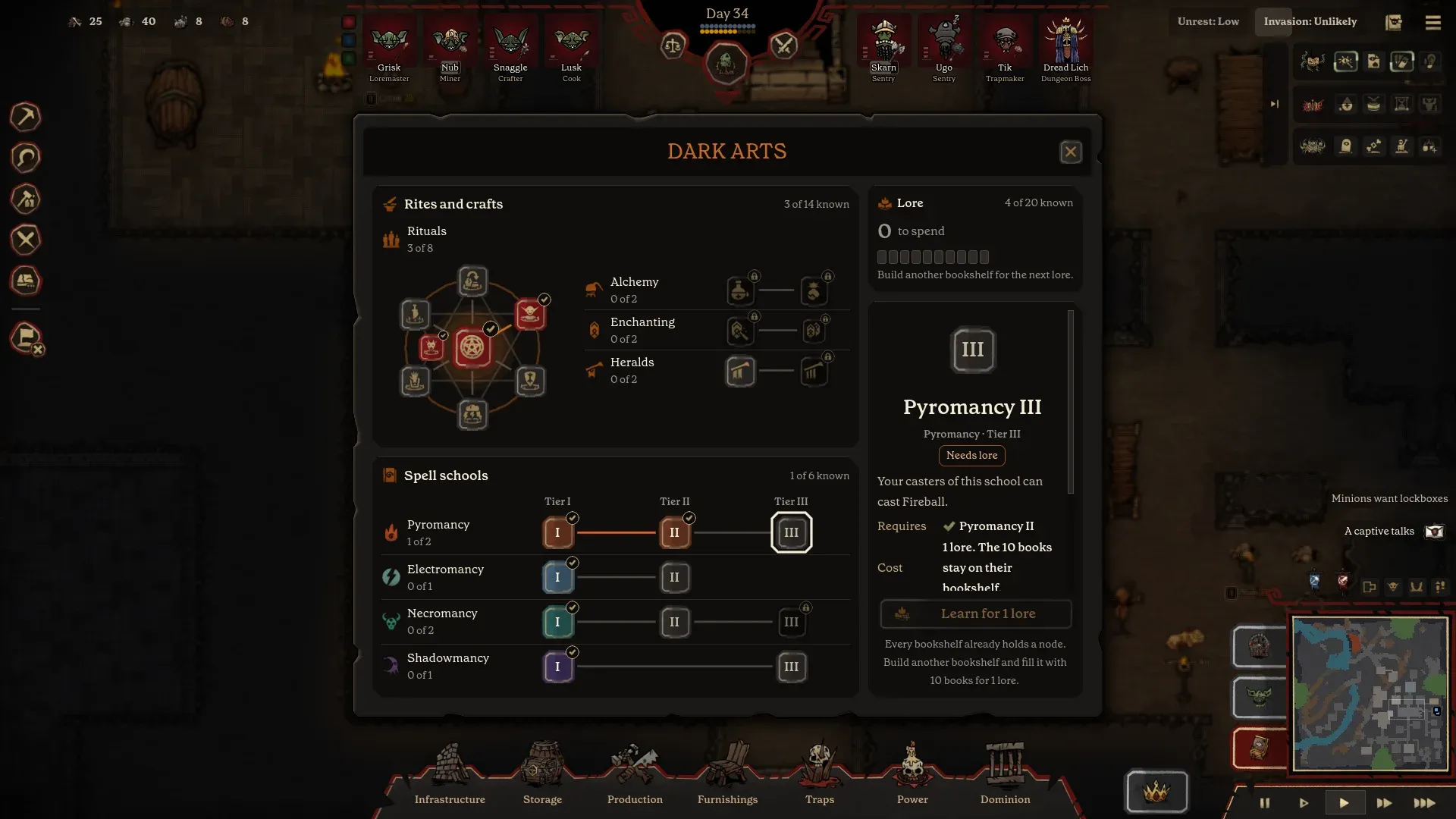
The official Dark Arts screen is a single window with three parts: rites and crafts at the top, spell schools below, and a detail panel on the right. That is a useful map of the system even without the numbers.
Confirmed magic facts
Confirmed
- Lore is the currency spent to learn spell nodes and rites.
- The official Pyromancy III tooltip shows a cost of 1 lore.
- Every bookshelf already holds a node. Building another bookshelf and filling it with 10 books produces 1 lore, according to the official tooltip.
- The Dark Arts screen in the press kit shows 3 of 14 rites and crafts known, and 1 of 6 spell nodes known.
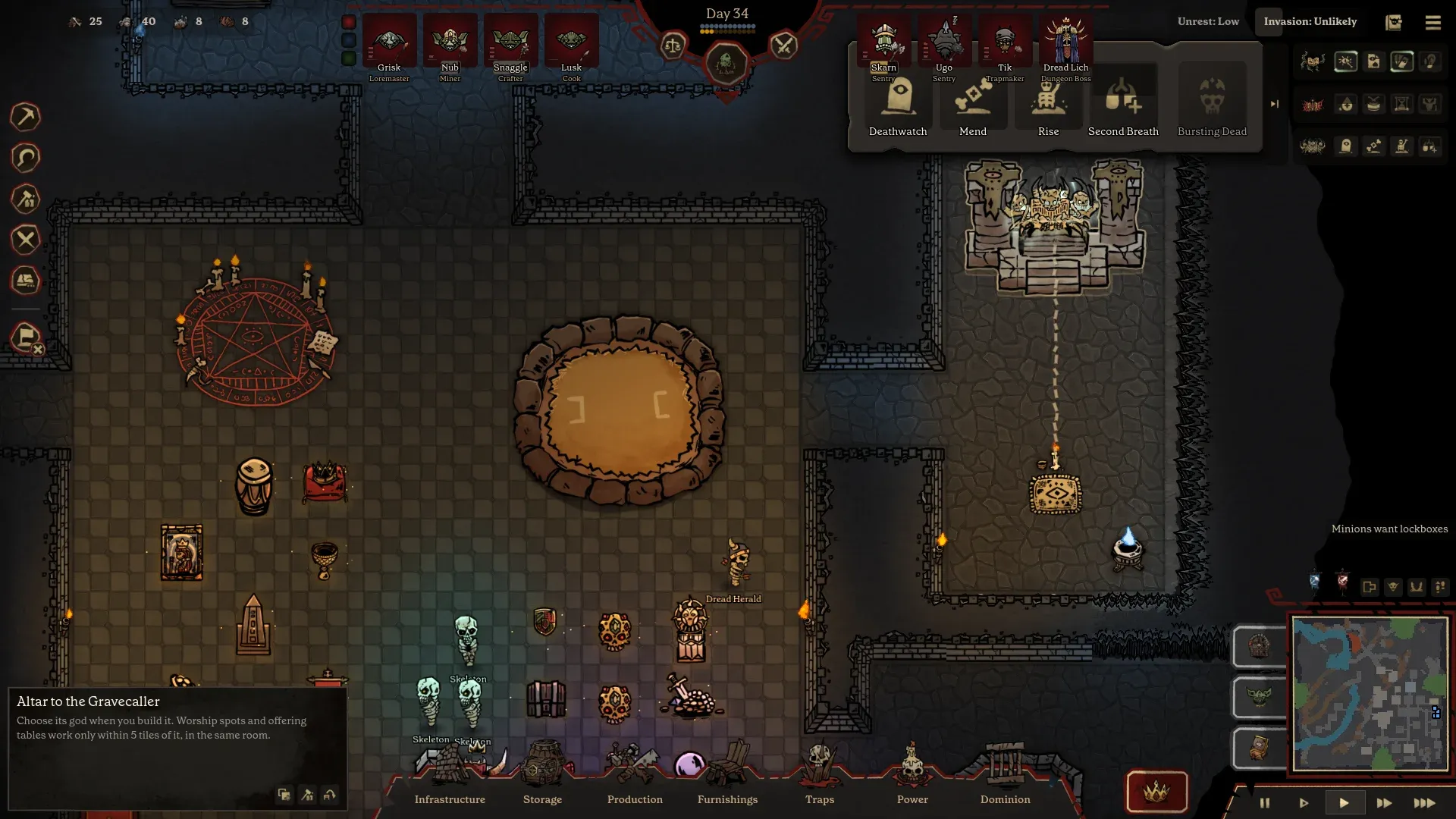
- The Altar to the Gravecaller tooltip says worship spots and offering tables work only within 5 tiles of it, in the same room.
Not announced
- The full spell list for each school.
- How many lore each school's later tiers cost beyond the Pyromancy III example.
- Which school owns Chain Lightning.
- The effects of the five Gravecaller boons.
- Whether minions can specialise in a school or must be assigned through gear.
- How many dark gods exist beyond the Gravecaller.
The four schools
Pyromancy
2 spell nodesFireball
The official Dark Arts screen shows Pyromancy I–III and selects Pyromancy III, which says: 'Your casters of this school can cast Fireball.'
Pyromancy III requires Pyromancy II and costs 1 lore. Fireball is also shown bursting over a fighting pit in official screenshots.
Electromancy
1 spell nodeNo school-locked spell named in the published UI
The official Dark Arts screen shows an Electromancy I–III track with 0 of 1 known.
Official combat screenshots show Chain Lightning, but the published Dark Arts screen does not show which school owns it. Do not assign it here without a source.
Necromancy
2 spell nodesNo spell named in the published UI
The official Dark Arts screen shows a Necromancy I–III track with 0 of 2 known.
The Dread Lich and its bound skeletons are separate boss mechanics; the published screen does not confirm that they use the Necromancy school.
Shadowmancy
1 spell nodeNo spell named in the published UI
The official Dark Arts screen shows a Shadowmancy I–III track with 0 of 1 known.
No Shadowmancy spell effect has been published. Official art shows an ogre shadowmancer with a staff, but that is character art, not a spell list.
Chain Lightning is not assigned to a school
Official combat screenshots show a Chain Lightning spell. The published Dark Arts screen does not show which school owns it, and the action screenshot does not include the school tooltip. We have left it unassigned rather than guessing.
Lore and bookshelves
Lore is the currency that unlocks spell nodes and rites. The Pyromancy III tooltip gives the clearest economy example:
- Pyromancy III requires Pyromancy II and costs 1 lore.
- It unlocks Fireball for casters of that school.
- Every bookshelf already holds a node.
- Building another bookshelf and filling it with 10 books produces 1 lore.
That makes bookshelves both a research building and a logistics sink. The 10-books-per-lore rule is the only published conversion rate; do not assume every tier costs the same. The screenshot shows Pyromancy III as a 1-lore upgrade, but later nodes or other schools may differ.
Rites and crafts
The top half of the Dark Arts screen divides non-spell progression into four groups. The official screenshot shows the total counts and how many are known at that point in the build.
| Group | Total nodes | Known in screenshot | What the screen shows |
|---|---|---|---|
| Rituals | 8 total | 3 of 8 | The largest rite category shown in the official Dark Arts screen. Individual ritual names and effects are not readable in the published screenshot. |
| Alchemy | 2 total | 0 of 2 | A two-node craft line. The screenshot does not show what it produces. |
| Enchanting | 2 total | 0 of 2 | A two-node craft line. No enchantment names or effects are published. |
| Heralds | 2 total | 0 of 2 | A two-node craft line. The screenshot does not explain what a Herald is. |
The counts sum to 14 rites and crafts, matching the screen's “3 of 14 known” label. Individual ritual names, effects and costs are not readable in the published image, so this page does not list any.
The Gravecaller and the altar
Mossbomb says you can bargain with dark gods for boons. The only god named in the public material is the Gravecaller. Its altar has a concrete placement rule:
“Choose its god when you build it. Worship spots and offering tables work only within 5 tiles of it, in the same room.”
That rule makes the shrine a room-planning problem, not a decorative object. The altar, worship spots and offering tables need to share a room and stay within five tiles of the altar. If you expand the shrine later, keep the functional cluster together.
Deathwatch
Boons appear along the top of the altar UI; effects are not visible in the published screenshot.
Mend
Name confirmed. Effect not published.
Rise
Name confirmed. Effect not published.
Second Breath
Name confirmed. Effect not published.
Bursting Dead
Name confirmed. Effect not published.
The names suggest a mix of protection, healing, resurrection and death effects, but the published tooltip does not describe any of them. Do not build a strategy around a guessed boon effect.
A sensible research priority
Pick one school before you build a library. The Pyromancy screen shows a two-node school; the other schools have one or two spell nodes each in the current build. Spreading lore across all four schools early is likely to leave you with several tier-I options instead of one usable tier-III spell. This is a planning recommendation, not tested balance data.
What is unknown
- The full spell list and the school assignment of Chain Lightning.
- The effects and costs of all 14 rites and crafts.
- What each Gravecaller boon does and how offerings are consumed.
- Whether multiple gods can be worshipped in one dungeon.
- Whether minion school specialisation is permanent or gear-driven.
- How spellcasting is executed in combat and whether it costs a resource.
Sources
Sources for this page
- 01Official Malignus interface screenshots — Mossbomb
The press kit's 'Screenshots with the interface' set documents the New Dungeon flow, boss select, minion stats, duties, grumbles, behavior settings, trap build menu, wiring, Dark Arts, boss upgrades, prisoners, altar and overworld map. Used for observations that are not spelled out in the store copy.
- 02Malignus press kit and fact sheet — Mossbomb
Fact sheet, development history, feature list, character and creature art, screenshot captions, and permission for press and content creators to use the kit's media in coverage of Malignus.
- 03Malignus on Steam — Valve / Mossbomb
Store description, Early Access Q&A, tags, supported languages, features, system requirements and the storefront's November 12, 2026 date display.
- 04Mossbomb — the studio making Malignus — Mossbomb
Developer site. Confirms the November 13, 2026 Early Access date, $19.99 Early Access price, $29.99 planned 1.0 price, monthly updates, demo status, platforms, co-op and headline features.
- 05Malignus — Demo Launch Trailer (2026) — Mossbomb
Official trailer used only for visual observations such as the Cinder Demon's fire effects and the Sunken Horror's tentacles.
Accessed 1 November 2026. Full source log and verification notes: Malignus Wiki sources.