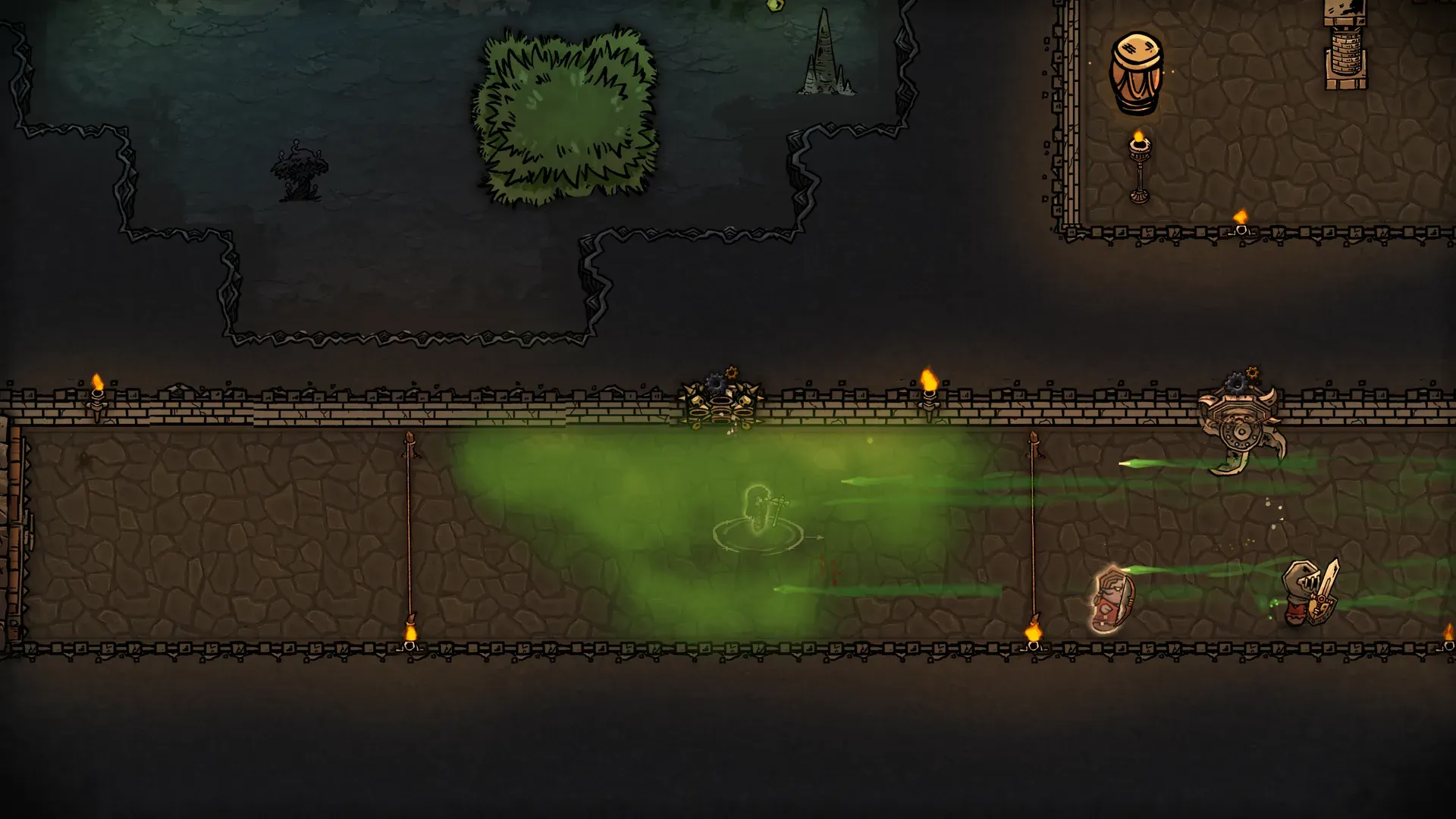
A trap corridor has one job: make a party spend time in a place where your dungeon can hurt it. Everything else — the trap names, the trigger choice, the decor — serves that sentence.
The public build gives you ten trap mechanisms and five trigger families, but almost none of the numbers. That is enough to design a defense stack. It is not enough to claim a mathematically optimal build, and this guide does not pretend otherwise.
What defense must do
- Delay. Slow the party down so more mechanisms can trigger and your minions can reach the fight.
- Separate. Break a tight formation. A corridor and a control effect can turn one party into a queue.
- Damage. Subtract health before your minions and Boss have to trade blows.
- Convert. Leave survivors alive for the Cell Block. Prisoners are a confirmed system, not a bonus afterthought.
- Preserve. Keep your own workers out of the kill zone and your Boss alive. A defense that kills three adventurers and your cook is a bad trade.
The defense stack
This is a design stack, not a required build order. The trigger and trap families are confirmed; the five-stage arrangement is editorial.
Trap roles
| Role | Confirmed options | How to use it | What not to assume |
|---|---|---|---|
| Direct damage | Dart Thrower, Spinning Blades, Flame Sprayer, Electric Coil, Blast Trap | Put a damage mechanism behind a trigger the party cannot miss. | Damage, area and cooldown are not published. |
| Area denial | Gas Sprayer | Fill a corridor to force movement or punish a pause. | Whether it affects your minions or ignores armor is unknown. |
| Control | Web Trap, Terror Trap | Hold or break a party so the damage layer gets more time. | Duration, escape chance and boss immunity are unknown. |
| Summon | Spider Trap | Add bodies behind the party or between them and the exit. | Swarm size, duration and control are not documented. |
| Utility | Alarm Trap | Create a warning line or separate a stealthed approach. | What it alerts and whether it wakes minions is not public. |
The numbers are not public
No official damage, radius, cooldown or friendly-fire value exists for these traps in the public material. Any guide that gives you exact DPS numbers is either datamining an unreleased build or making them up. Test in the demo and watch the results.
Trigger plan
The five published triggers behave differently in principle, even though their exact values are unknown:
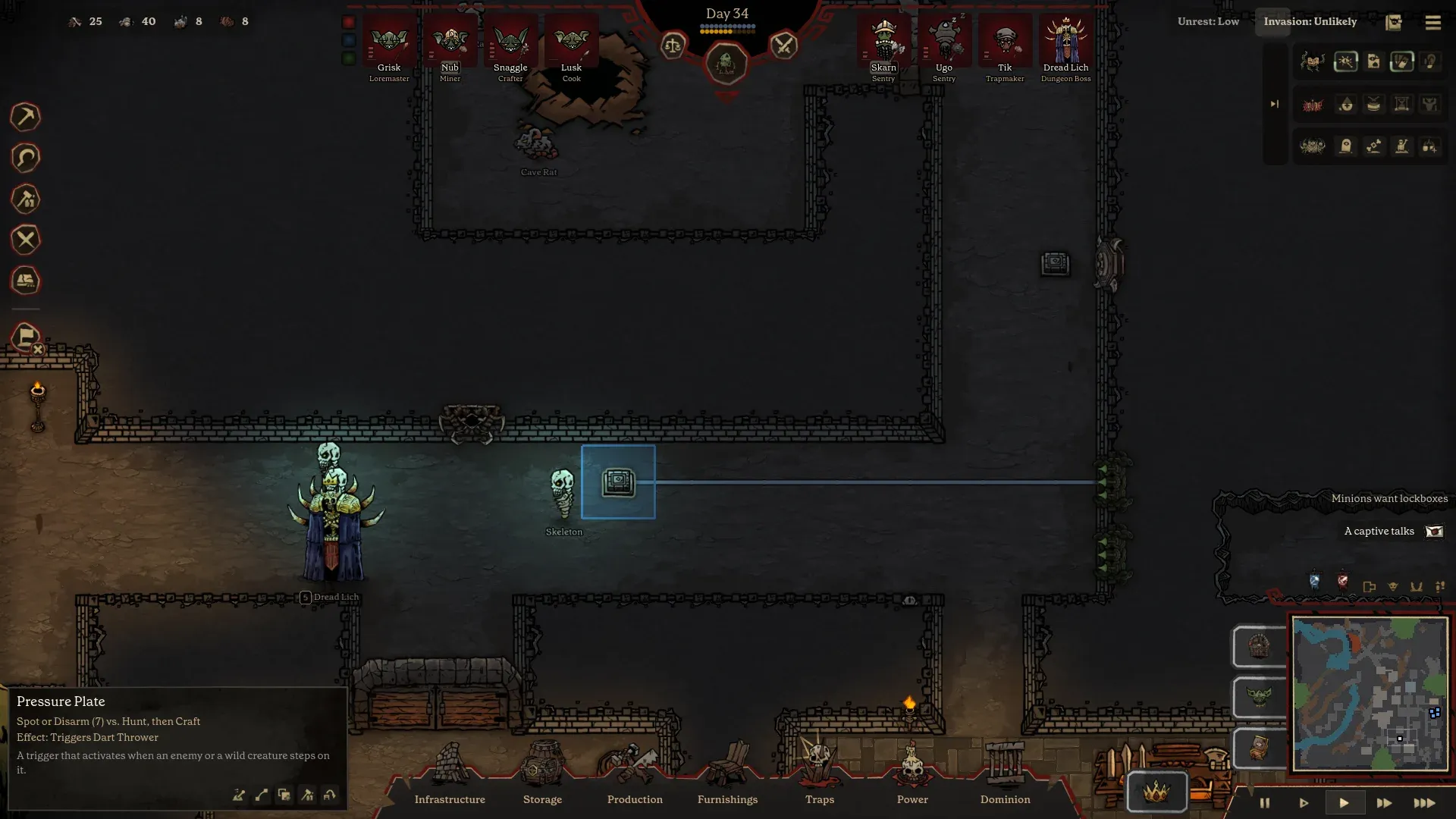
- Pressure plate: positional. The party must step on it. The official example wires one to a Dart Thrower.
- Tripwire: a line trigger. Useful when you expect a specific path through a corridor.
- Sensor: detection-based. The obvious choice for an area or a flank, but its filters are undocumented.
- Lever: manual. Good for a reserve trap you want to fire on command, assuming a minion can operate it.
- Timer: rhythmic. Potentially useful for a repeating hazard, but the interval settings are not published.
For a first corridor, start with a pressure plate and one damage trap. The official wiring screenshot gives you a confirmed example. Then add a second trigger farther down the corridor, so a party that survives the first hit meets another decision.
Test the circuit before the invasion
- Build one trigger and one mechanism.
- Send a minion through the trigger zone. Watch whether the trap fires and whether the minion is harmed.
- If the minion is harmed, add a service route or restrict worker access.
- Add a second mechanism and test again. Do not stack five unknowns.
- Only then add a control or utility layer.
Minions and the Boss
Traps are a force multiplier, not a replacement for bodies. The official material presents the corridor as one part of a defense that also includes minions, doors and the Boss.
- Put the Boss behind the first line, not at the entrance. It should be able to reach the fight without being the first thing the party meets.
- Keep a response squad. One or two combat-capable minions with real weapons, set to stay in the domain during a raid.
- Send non-combatants away. Use “Retreat on invasion” and “Confine to Domain” on cooks, scholars and haulers.
- Keep a healer or healing plan. The Behavior tab has a “Seek healing” setting; the exact healing system is not fully documented.
- Use the Cell Block. A corridor that leaves survivors alive is more valuable if you have a prison and guards ready.
Invasion-day checklist
After the fight
The defense does not end when the last adventurer falls. Prisoners need chains, guards and interrogation. Wounded minions may complain or become less effective. The Boss may have taken an Extreme wound in front of the crew, which the Grumbling log can surface as “Saw the Boss get wounded.”
Treat the post-fight state as the start of the next defense: heal, restock, replace losses and read the complaints. The minion management guide has the recovery routine.
Common mistakes
A corridor with no second line
If the party reaches the end alive, the defense has to continue. Put bodies, doors or another trap behind the first line.
Five damage traps, no control
A tough party can walk through raw damage. Control buys time for the damage to matter.
Traps in an open room
A trigger is only reliable if the party has to cross it. Use a corridor or a doorway.
Ignoring friendly fire
The public build does not confirm that your minions are safe. Test before you automate a worker route.
Spending the whole budget on traps
Food, beds and gear keep the dungeon running between invasions. A starving crew cannot man the corridor.
No prison plan
Prisoners are a system. If you cannot hold them, you are creating a future problem.
Sources
Sources for this page
- 01Malignus on Steam — Valve / Mossbomb
Store description, Early Access Q&A, tags, supported languages, features, system requirements and the storefront's November 12, 2026 date display.
- 02Official Malignus interface screenshots — Mossbomb
The press kit's 'Screenshots with the interface' set documents the New Dungeon flow, boss select, minion stats, duties, grumbles, behavior settings, trap build menu, wiring, Dark Arts, boss upgrades, prisoners, altar and overworld map. Used for observations that are not spelled out in the store copy.
- 03Malignus press kit and fact sheet — Mossbomb
Fact sheet, development history, feature list, character and creature art, screenshot captions, and permission for press and content creators to use the kit's media in coverage of Malignus.
- 04Mossbomb — the studio making Malignus — Mossbomb
Developer site. Confirms the November 13, 2026 Early Access date, $19.99 Early Access price, $29.99 planned 1.0 price, monthly updates, demo status, platforms, co-op and headline features.
- 05Malignus — Demo Launch Trailer (2026) — Mossbomb
Official trailer used only for visual observations such as the Cinder Demon's fire effects and the Sunken Horror's tentacles.
Accessed 1 November 2026. Full source log and verification notes: Malignus Wiki sources.