Your first raid is not a loot button. It is a commitment: you split your attention and your combat power between the overworld and a dungeon that still needs feeding. The reward is treasure, and treasure is both a Boss upgrade and a bigger target painted on your hoard.
Before you leave
Do not raid until the dungeon can run without the minions you are taking. The official HUD tracks Unrest and Invasion; check both before you commit.
The first threshold is the useful one
The official boss screen says level 2 arrives at 5 treasure and level 5 at 30. That makes the first 5 treasure a clear early target: a short, successful raid can improve your Boss before the first serious invasion. This is a planning inference, not a tested route.
Read the map
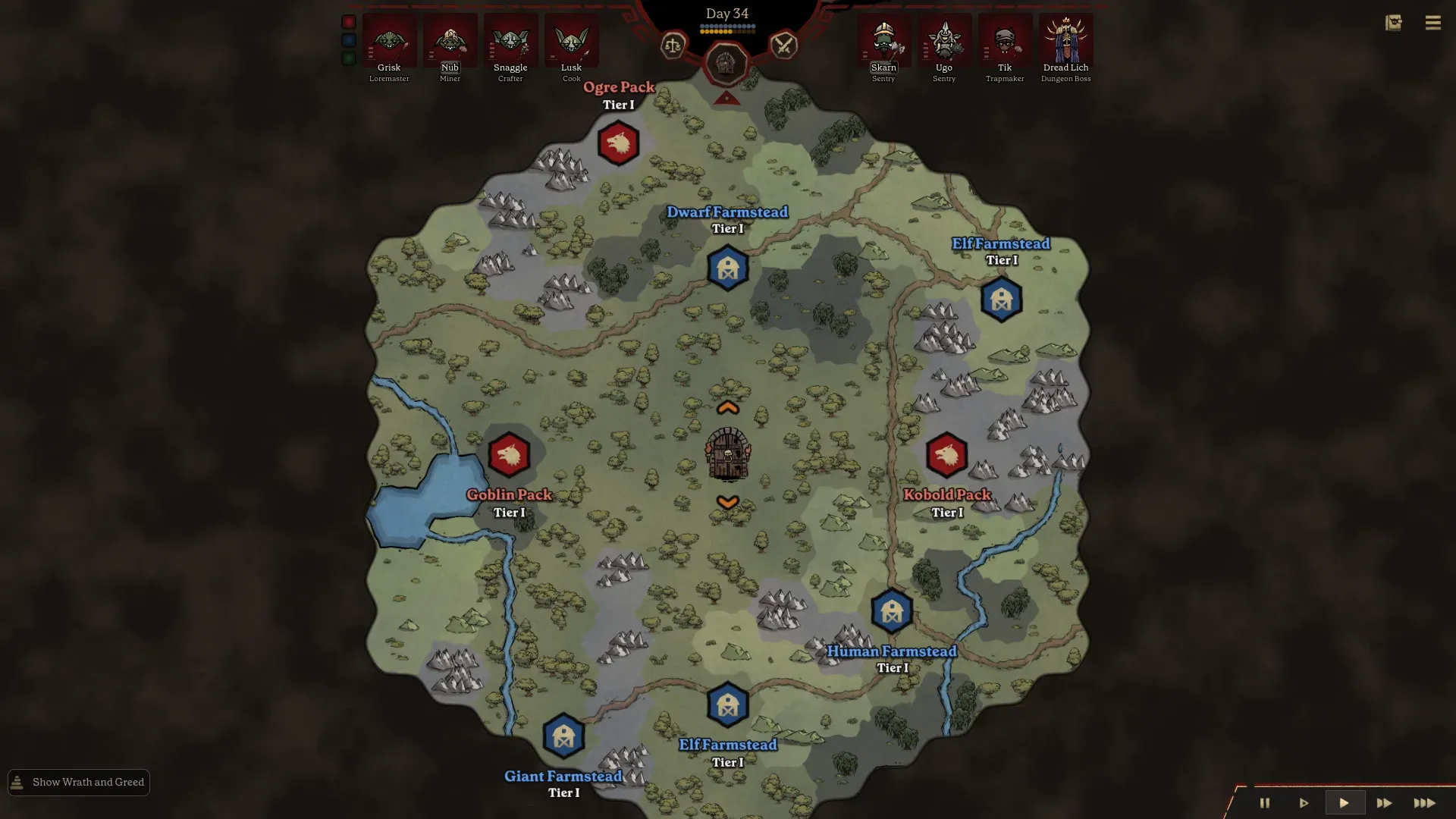
The overworld is a hex map with the dungeon gate at the center. The official screenshot shows two target families:
- Farmsteads in blue: dwarf, elf, human and giant. These are settlement targets.
- Monster packs in red: goblin, kobold and ogre. These are a different kind of target.
Every visible target has a Tier I label. The public material does not explain what a tier changes, how it rises, or whether farmsteads and monster packs give different loot. The safe assumption is that Tier I is the introductory band; the safe behavior is to scout and test rather than assume a farmstead is easier than a pack.
The map also shows a “Show Wrath and Greed” toggle. Its effect is not documented. Do not treat it as a difficulty switch or a reward multiplier without testing.
Choose a target
The first raid should answer a question, not win the game. Pick a target whose defenders you can plausibly beat and whose loss you can survive. Without published loot tables, the choice comes down to three practical questions:
- What can my party handle? You know your minions' stats and gear. Use them.
- What can I afford to lose? Leave the specialists at home. Take fighters who can be replaced.
- What happens if I come home wounded? The invasion after the raid is the second fight. Do not spend the force you need for it.
The official map labels farmsteads and packs separately, but no public source ranks their difficulty. Our recommendation is to start with the target type that matches the troops you have, not with a guess about which icon gives better loot.
Assemble the party
The game does not publish a raiding-party cap, a class system for minions, or whether the Boss can join a raid. The official screenshot shows minions fighting in the overworld, including spellcasters, so a mixed party is the visual model.
| Role | What to bring | Why |
|---|---|---|
| Front line | High-Battle minions with real weapons and armor. | Someone has to absorb the defenders' attention. |
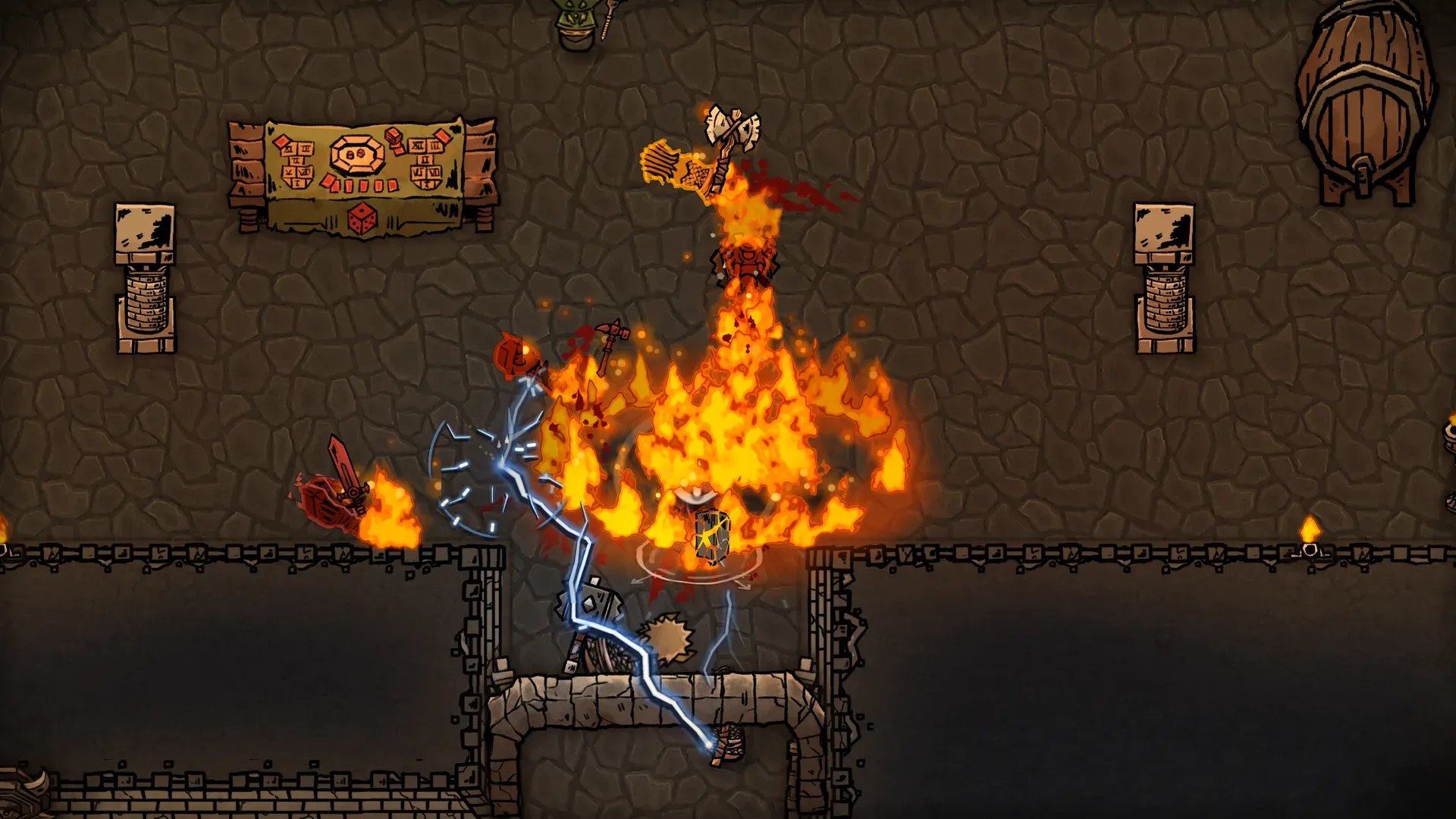
| Casters | Minions with offensive spells from the Dark Arts progression. | Official raid footage shows Fireball and Chain Lightning in the overworld. |
| Support | A healer or a minion with the best available gear. | The published material does not detail raid healing, so bring a reserve plan. |
| Home guard | At least one fighter, the Boss and a working trap corridor. | The dungeon does not stop existing while you are away. |
Command the raid
Raids are commanded in real time. The official material does not say whether you can pause, slow time or issue orders while the dungeon continues to simulate. Treat it as a live fight and plan for the worst: you may not have unlimited time to inspect every tooltip.
- Open with the plan you rehearsed. Do not invent a new formation while the defenders are moving.
- Use spells on clusters. The official footage shows area spells landing on groups; that is the visual argument for a caster.
- Watch the exit. A routed defender is still a defender. The dungeon screenshots show routed adventurers running into traps; the overworld may have its own retreat behavior.
- Do not chase loot into a second fight. The objective is to bring treasure home, not to clear the map.
Bring the loot home
Treasure must be carried back to the dungeon. The official screenshot shows a minion carrying raided treasure to the door of the sanctum. Once it is home, it contributes to the hoard and to the Boss's treasure thresholds.
There is no published rule for partial raids, dropped loot or whether a failed raid leaves the treasure on the map. Do not assume you can recover a lost haul.
The invasion after
The store description is direct: the treasure you steal is the reason adventurers come to take it back. The overworld and the dungeon are one economy. A successful raid changes the next defense.
- Re-check Invasion and Unrest. The status may change after the raid.
- Heal and re-equip. A raid party that comes home wounded is not ready for a counter-invasion.
- Repair the corridor. Replace consumed traps and check the wiring.
- Spend the boss points. Level 2 gives two upgrade points. Check the Boss's upgrade tab.
- Read the grumbles. A hard fight leaves social and morale consequences.
If the counter-invasion arrives before you are ready, fall back to the first-invasion checklist and let the corridor do the work.
Raid mistakes
Taking the whole army
The dungeon still needs a defense. Leave a fighter, the Boss and a tested corridor at home.
Raiding on an empty pantry
A raid does not pause hunger. The colony can starve while you are winning.
Assuming Tier I means easy
The tier label is not a difficulty guarantee in the public material.
Ignoring the return invasion
The loot is the bait. Plan the defense before you launch the raid.
Forgetting the Boss upgrade
Level 2 at 5 treasure is an immediate power spike. Spend the points.
Treating a failed raid as a reset
No recovery rule for lost loot has been published. Play as if the loss is permanent.
Sources
Sources for this page
- 01Official Malignus interface screenshots — Mossbomb
The press kit's 'Screenshots with the interface' set documents the New Dungeon flow, boss select, minion stats, duties, grumbles, behavior settings, trap build menu, wiring, Dark Arts, boss upgrades, prisoners, altar and overworld map. Used for observations that are not spelled out in the store copy.
- 02Malignus press kit and fact sheet — Mossbomb
Fact sheet, development history, feature list, character and creature art, screenshot captions, and permission for press and content creators to use the kit's media in coverage of Malignus.
- 03Malignus on Steam — Valve / Mossbomb
Store description, Early Access Q&A, tags, supported languages, features, system requirements and the storefront's November 12, 2026 date display.
- 04Mossbomb — the studio making Malignus — Mossbomb
Developer site. Confirms the November 13, 2026 Early Access date, $19.99 Early Access price, $29.99 planned 1.0 price, monthly updates, demo status, platforms, co-op and headline features.
- 05Malignus — Demo Launch Trailer (2026) — Mossbomb
Official trailer used only for visual observations such as the Cinder Demon's fire effects and the Sunken Horror's tentacles.
Accessed 1 November 2026. Full source log and verification notes: Malignus Wiki sources.